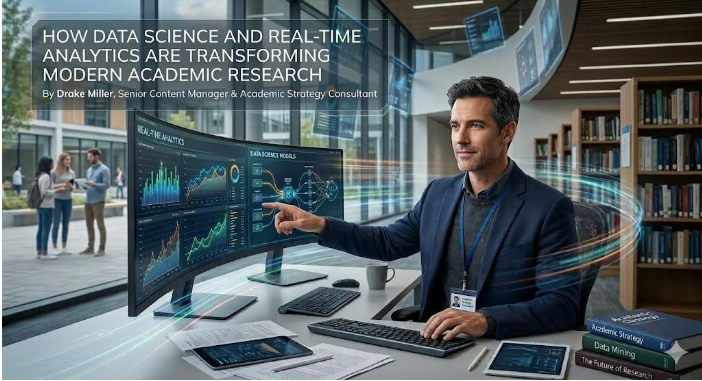
By Drake Miller – Senior Content Manager & Academic Strategy Consultant
The landscape of academic inquiry is undergoing a seismic shift. Whether you are a high school senior planning a competitive STEM project or a university student tackling a complex thesis, the “old way” of doing research is rapidly evolving. Traditionally, research was a slow, methodical process involving manual data collection and months of analysis. Today, students often seek professional assignment help at Myassignmenthelp.com to navigate these increasingly technical requirements.
For high school students preparing for university and current researchers alike, understanding these technologies is no longer optional. They are the primary engines driving innovation in fields ranging from molecular biology to urban sociology. By leveraging these tools, the academic community is moving from a reactive “what happened?” approach to a proactive “what is happening right now, and what will happen next?” model.
The Convergence of Big Data and Academia
At its core, Data Science uses scientific methods and algorithms to extract insights from structured and unstructured data. In modern research, this means handling datasets so massive that traditional software simply cannot process them. This shift is particularly evident in quantitative fields; for instance, students managing complex financial datasets often require specialized accounting assignment help to apply these data principles to fiscal modeling and auditing.
Real-time analytics takes this a step further. Instead of analyzing data after a study has concluded, researchers can now monitor data streams as they are generated. Whether it’s sensor data from a climate station in the Arctic or social media sentiment during a global event, the ability to process information instantaneously is revolutionary. This shift is particularly relevant for students in the USA and UK, where research funding is increasingly directed toward “active” and “impact-oriented” studies.
1. Accelerating the Discovery Phase: From Months to Milliseconds
The most immediate impact of data science in research is speed. In the past, a PhD student might spend a whole semester just cleaning and organizing data. Today, machine learning algorithms can categorize millions of data points in seconds.
In medical research, for instance, data science allows for “in silico” testing—simulating drug interactions on a computer before ever reaching a physical lab. This doesn’t just save time; it saves lives by accelerating the development of vaccines and treatments. For students entering STEM fields, mastering Python or R is becoming as fundamental as learning to write a lab report.
Furthermore, the automation of literature reviews through Natural Language Processing (NLP) allows researchers to scan thousands of peer-reviewed journals to find gaps in existing knowledge. This ensures that new research is truly “novel” and not a duplication of previous efforts.
2. Precision and Predictive Modeling in STEM
Modern research is increasingly focused on prediction. By applying predictive analytics to historical data, researchers can identify patterns that are invisible to the human eye. This is a crucial area for students interested in environmental science, economics, and engineering.
In environmental science, real-time analytics are used to predict forest fires or flash floods. Sensors placed in high-risk zones feed data into models that analyze humidity, wind speed, and temperature in real-time. This allows researchers to provide early warnings, transforming a research project into a life-saving tool. In the US, universities are leading the way in “Smart City” research, using real-time traffic and energy data to build more sustainable urban environments.
3. Revolutionizing Social Sciences and the “Digital Humanities”
It isn’t just the “hard sciences” that benefit. Data science is breathing new life into the humanities. “Digital Humanities” is a rapidly growing field where researchers use text mining and NLP to analyze thousands of historical documents simultaneously.
Imagine analyzing every speech given in the U.S. Senate over the last 50 years to track the evolution of political rhetoric. Without data science, this would be a multi-decade project involving hundreds of assistants. With modern tools, a single researcher can produce a comprehensive analysis in a matter of weeks, identifying subtle shifts in language that reflect broader societal changes. This interdisciplinary approach—combining coding with history or sociology—is exactly what top-tier universities are looking for in prospective students.
4. Enhancing Collaboration and the “Open Science” Movement
Real-time analytics fosters a level of global collaboration previously thought impossible. Cloud-based platforms allow researchers from different continents to work on the same live dataset simultaneously. As new data flows in—perhaps from a telescope in Hawaii or a particle accelerator in Switzerland—the entire global team sees the updates instantly.
This transparency supports the Open Science movement. When data is processed in real-time and shared openly, it reduces the likelihood of errors and allows for immediate peer review. For high school and college students, this means the “ivory tower” of academia is becoming more accessible. You can often find open-source datasets on platforms like Kaggle or GitHub to conduct your own high-level research projects.
Starter Project Ideas for Students (High School & Above)
If you are looking to build your resume or college application, here are a few ways to apply these concepts today:
- Climate Change Tracking: Use open-source NASA data to create a predictive model of local temperature shifts over the next decade.
- Social Media Sentiment: Use Python to analyze Twitter/X or Reddit sentiment regarding a specific US legislative bill to see how public opinion shifts in real-time.
- Public Health: Use CDC data to map the spread of seasonal flu in your state and identify “hotspots” using heat-mapping software like Tableau.
- Economics: Analyze the relationship between local unemployment rates and retail spending using publicly available government datasets.
Overcoming the Challenges: The Ethics of Data
With great power comes great responsibility. The integration of data science into research brings significant ethical hurdles, particularly regarding data privacy and algorithmic bias.
If a data model is trained on biased historical data, the research outcomes will reflect those biases. Academics are now tasked with not only being experts in their subject matter but also being ethically literate in data management. This is a crucial area of study for the next generation of scholars: ensuring that technology serves all of humanity fairly. Discussion of “Data Ethics” is currently one of the highest-trending topics in US higher education.
The Skillset for the Future Researcher
For students looking to excel in this new era, the “traditional” academic path is changing. To stay competitive, you should focus on developing a T-shaped skillset:
- Statistical Literacy: You don’t need to be a math genius, but you must understand the math behind the models to interpret results accurately.
- Programming Skills: Proficiency in languages like Python, SQL, or R is the new “literacy.”
- Data Visualization: The ability to communicate complex findings through clear, interactive charts and maps (using tools like PowerBI or D3.js).
- Critical Thinking: Knowing when to trust the data and when to question the algorithm. This is where human expertise remains irreplaceable.
How to Bridge the Technical Gap
If you are a student feeling overwhelmed by the technical demands of modern assignments, you aren’t alone. The jump from standard classroom learning to high-level data-driven research is steep. Many students find that seeking professional guidance can bridge this gap and help them maintain their GPA while learning these new tools.
Conclusion
Data science and real-time analytics are not just “trends”—they are the new foundation of the academic world. They allow us to solve bigger problems, faster and with more precision than ever before. Whether you are investigating the stars, the climate, or human behavior, these tools provide the lens through which we will view the discoveries of the 21st century.
By embracing these technologies today, students and researchers are not just observing the future; they are actively building it.
Frequently Asked Questions
Q.1 Do I need to be a math genius to use data science in research?
Not necessarily. While a foundation in statistics is helpful, many modern tools have user-friendly interfaces. The most important skill is “data intuition”—understanding what questions to ask of your data and how to interpret the answers.
Q.2 What is the difference between data science and statistics?
Statistics focuses on quantifying uncertainty and testing hypotheses on smaller, often “clean” datasets. Data science is broader, incorporating computer science, coding, and the handling of massive, “messy” data to find unexpected patterns.
Q.3 Is real-time analytics expensive for students?
It can be, but many academic institutions in the US and UK provide students with free access to powerful cloud computing resources like AWS Educate or Google Cloud for Students. There are also many free, open-source tools available for those just starting out.
Q.4 How can data science help in non-STEM subjects?
In subjects like History or Literature, data science allows for “Macro-analysis.” Instead of reading one book, you can analyze the sentiment and vocabulary of 10,000 books written in the same era to find cultural trends that no single human reader could ever spot.