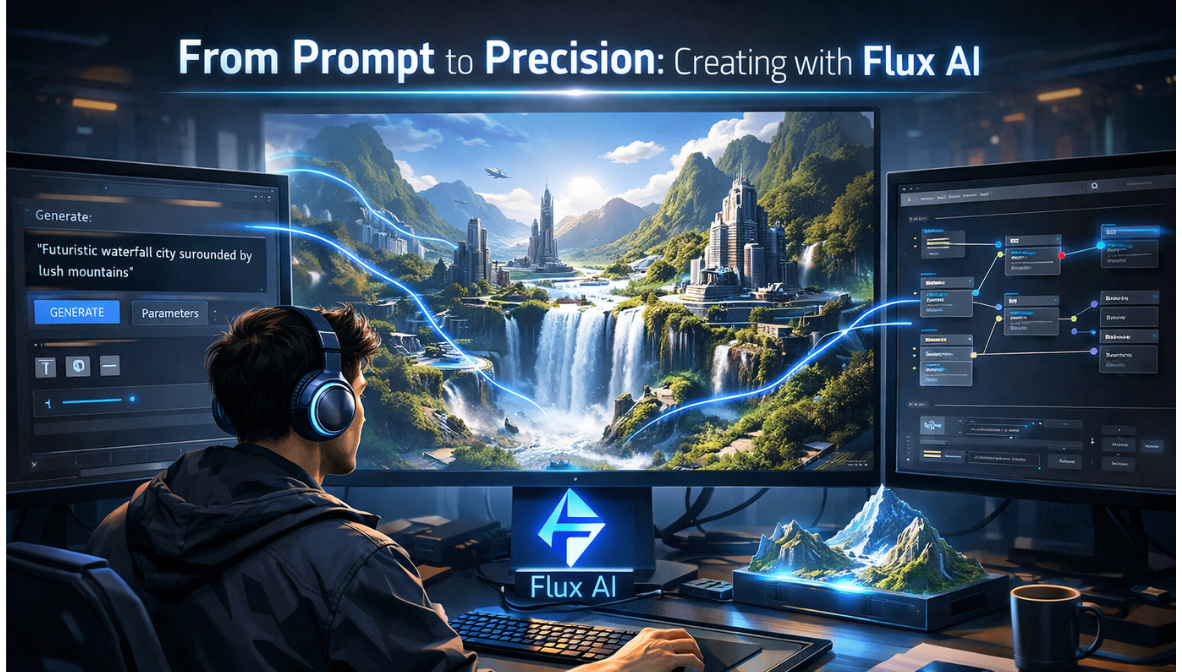
Creative workflows are evolving faster than ever. What once required hours of manual design, repeated revisions, and specialized technical skills can now begin with a single well-crafted prompt. The shift isn’t just about speed—it’s about precision. Modern creators are no longer satisfied with rough outputs; they want results that reflect intent, context, and consistency from the very first iteration.
This is where flux AI enters the conversation. As prompt-driven creation matures, flux AI represents a move toward systems that understand nuance rather than just keywords. Instead of generating generic visuals, it interprets creative intent, maintains continuity, and allows creators to refine outputs with far greater control. When used thoughtfully, tools powered by flux AI can turn abstract ideas into highly specific, polished results.
In practice, this approach is already influencing how images and videos are created, especially on platforms like Invideo, where flux AI-driven capabilities are applied to image generation and editing with contextual awareness. The result is a workflow that feels less mechanical and more collaborative—almost like working with a creative partner that understands direction instead of guessing it.
Understanding the Shift from Prompts to Precision
Why Prompt Quality Alone Is No Longer Enough
Early AI creation tools placed enormous responsibility on the prompt itself. Creators had to experiment endlessly with wording, structure, and modifiers to get usable results. While this taught valuable lessons about prompt engineering, it also revealed a limitation: even great prompts couldn’t always guarantee accuracy or consistency.
Precision requires more than language interpretation. It demands an understanding of visual relationships, context, and continuity across multiple outputs. Without this, creators often end up correcting the same elements repeatedly—faces changing between scenes, backgrounds losing coherence, or styles drifting unpredictably.
Precision as a Creative Multiplier
Precision doesn’t restrict creativity; it amplifies it. When creators trust that core elements will remain consistent, they’re free to focus on storytelling, composition, and experimentation. Instead of wrestling with the tool, they can explore variations confidently, knowing the system will respect their intent.
This shift transforms AI from a novelty into a dependable creative layer—one that supports iteration without sacrificing control.
How Flux AI Enables Context-Aware Creation
Flux AI and Intelligent Interpretation
In the second phase of modern AI creation, flux AI stands out for its focus on contextual understanding. Rather than treating each prompt as an isolated request, it considers how elements relate to one another within a scene. This means objects, characters, and environments behave more predictably across revisions.
On platforms like Invideo, flux AI is applied through features such as Flux Kontext, enabling creators to generate and edit images while preserving character consistency and visual logic. This approach is especially useful when refining details without altering the entire composition.
Local Precision Editing Without Creative Disruption
One of the most valuable aspects of context-aware AI is localized editing. Instead of regenerating an entire image to fix a small issue, creators can adjust specific areas while keeping everything else intact. This dramatically reduces friction and keeps creative momentum flowing.
For example, refining facial expressions, adjusting lighting in a single area, or modifying background elements becomes a targeted action rather than a full restart. Precision like this brings AI workflows closer to traditional design tools—while still retaining the speed advantage of automation.
From Static Images to Dynamic Storytelling
Visual Consistency Across Creative Assets
Consistency is essential for storytelling. Whether you’re creating educational visuals, social content, or narrative sequences, visual drift can break immersion. AI systems that lack contextual memory often struggle here, producing outputs that feel disconnected.
Flux AI-driven creation emphasizes continuity. Characters maintain recognizable features, environments remain stable, and stylistic choices persist across multiple outputs. This makes it easier to build cohesive visual stories without excessive manual correction.
Bridging Images and Motion
As static visuals increasingly feed into motion content, the need for precision grows even stronger. Creators often move from images into short videos, explainers, or animated sequences. In these cases, even minor inconsistencies become more noticeable.
This is where workflows connected to an AI video app become especially valuable. When image generation and video creation align under the same contextual logic, creators can transition smoothly from still visuals to motion without reworking foundational elements.
Creative Control Without Complexity
Reducing the Learning Curve
Traditional design software offers precision, but often at the cost of complexity. AI tools aim to lower that barrier, but early versions sometimes swung too far in the opposite direction, offering ease without control.
Flux AI helps balance this equation. By embedding intelligence into the system rather than the user’s workflow, it allows creators to achieve detailed results without mastering technical interfaces. Precision becomes accessible, not overwhelming. scookiegeek, feedbuzzard, thehometrotters,
Iteration That Feels Natural
Creative work is rarely linear. Ideas evolve through iteration, refinement, and occasional course correction. Context-aware AI supports this reality by remembering prior decisions and adapting to changes incrementally.
Instead of starting over with each adjustment, creators can build on what already works. This makes experimentation feel less risky and far more rewarding.
Practical Use Cases for Precision-Driven AI Creation
Educational and Instructional Content
Clear visuals are critical in learning environments. Inconsistent imagery can confuse rather than clarify. Precision-focused AI enables educators and content creators to maintain visual continuity across diagrams, characters, and scenarios.
This consistency helps learners focus on the message instead of being distracted by visual changes that don’t serve the lesson.
Marketing and Brand Storytelling
While this discussion avoids promotion, it’s worth noting that storytelling benefits from recognizable visual elements. Precision ensures that recurring visuals feel intentional rather than accidental, strengthening narrative cohesion over time.
Flux AI-powered workflows support this by keeping visual identities stable across multiple creative outputs.
Creative Exploration and Concept Development
Artists and designers often use AI for ideation. Precision doesn’t limit this process—it enhances it. When creators know they can refine specific aspects without losing the overall concept, they’re more willing to explore bold ideas.
AI becomes a sketchbook that remembers what matters.
The Future of Prompt-Driven Creation
Moving Beyond Guesswork
The future of AI creation lies in reducing guesswork. As systems like flux AI continue to evolve, creators will spend less time tweaking prompts and more time shaping outcomes intentionally.
This doesn’t eliminate creativity; it redirects effort toward higher-level decisions that truly define the work.
Human Intent at the Center
Ultimately, precision-driven AI works best when it amplifies human intent rather than replacing it. Tools that understand context, preserve continuity, and respect creative direction feel less like machines and more like collaborators.
As platforms such as Invideo continue integrating flux AI capabilities into image and visual workflows, the line between idea and execution becomes thinner—allowing creators to move from prompt to precision with confidence.
Conclusion: Precision Is the New Creative Standard
The evolution from prompt-based experimentation to precision-driven creation marks a significant shift in how we work with AI. Tools powered by flux AI demonstrate that accuracy, consistency, and creative freedom don’t have to be trade-offs. comprehensive guide logicalshout
By embracing context awareness, localized editing, and continuity, creators can produce work that feels intentional, polished, and aligned with their vision. The future of AI creation isn’t about generating more—it’s about creating better, with purpose and precision at every step.

